

Roulette is one of the most iconic and visually captivating games in the world of casino gambling
M88 Online Casino will explain the definition of Roulette, one of the most favorite casino games.
Your trusted gateway to M88 — Where Asia Plays
The spinning wheel, the small ivory ball dancing along its rim, and the final suspenseful drop into a numbered pocket have defined casino floors for centuries. Unlike Blackjack, where player decisions can influence long-term outcomes, Roulette is a pure game of probability. However, a solid understanding of chips, betting structures, and payout mechanics is essential for any serious bettor.
- How to Play Blackjack: M88 Casino guideline
- M88 Online Casino introduces: Tiger Baccarat – How to Play and Understand the Special Side Bets
M88 Online Casino: Chips in Roulette
Roulette uses two primary types of chips: cash chips and colour chips.
Cash chips carry a fixed monetary value and can be exchanged directly at the table or at the casino cashier. They are universal within the casino and may be used at any gaming table. If you decide to move to another table, you may take your cash chips with you or redeem them at the cage.
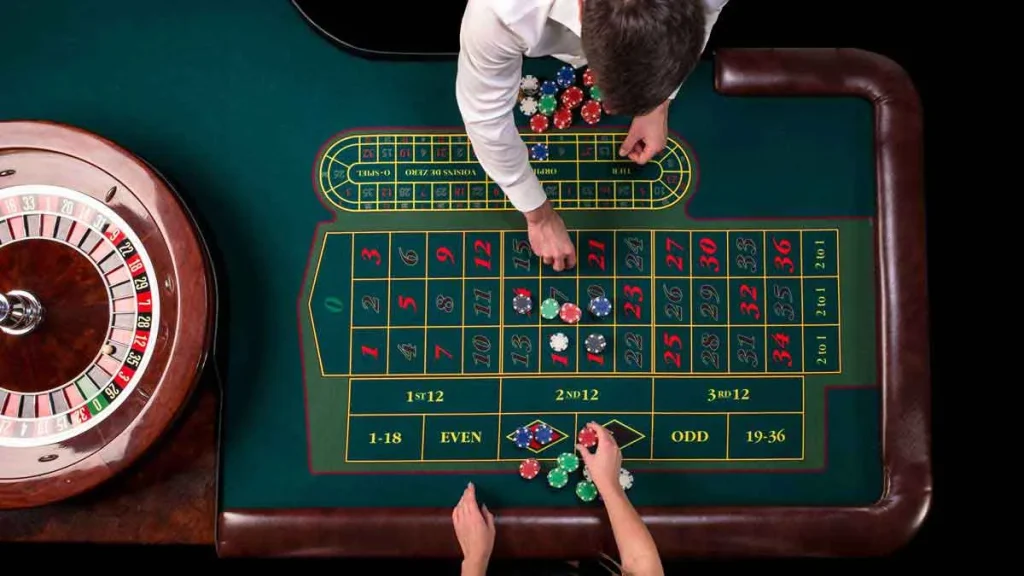
Colour chips, on the other hand, are issued to distinguish players at the same table. Each player is assigned a unique colour. These chips have value only at the specific table where they were issued and cannot be used elsewhere.
Typically, the denomination of colour chips corresponds to the table’s minimum bet. However, players may request higher denominations depending on their wagering preference. When leaving the table or switching games, colour chips must be converted back into cash chips.
Understanding chip management is fundamental, particularly at busy tables where multiple players are placing simultaneous wagers.
How Roulette Is Played
A standard European Roulette wheel consists of numbers 1 through 36, alternating in red and black, plus a single green zero. (The American version includes both 0 and 00, increasing the house edge.) The objective is straightforward: predict where the ball will land after the wheel is spun.
A typical round follows this sequence:
- Players place chips on individual numbers or combinations of numbers on the betting layout.
- The croupier (dealer) may assist in placing bets upon request, but players are responsible for ensuring wagers are correctly positioned.
- The croupier spins the wheel in one direction and launches the ball in the opposite direction.
- Betting remains open until the croupier announces “No more bets.”
- Once the ball settles into a numbered pocket, the result is announced and marked with a dolly.
- Losing bets are cleared first, followed by payment of winning wagers according to the payout schedule.
Each spin is an independent event. Previous outcomes have no statistical influence on future results — a principle that seasoned bettors must always respect to avoid the gambler’s fallacy.
Types of Bets in Roulette
Roulette wagers are divided into Inside Bets and Outside Bets, each offering a different balance between risk and reward.
Inside Bets
Inside bets cover specific numbers or small clusters of numbers. They offer higher payouts but lower probabilities of success.
– Straight Up: A single number, including 0. Pays 35:1.
– Split: Two adjacent numbers. Pays 17:1.
– Street: Three numbers in a horizontal row. Pays 11:1.
– Corner (Square): Four adjacent numbers forming a square. Pays 8:1.
– Top Line (0-1-2-3 in American Roulette): Pays 8:1.
– Six Line (Double Street): Six numbers across two adjacent rows. Pays 5:1.
Outside Bets
Outside bets cover larger sections of the layout. They provide higher hit frequency but lower payout ratios.
– Column Bet: One vertical column of 12 numbers. Pays 2:1.
– Dozen Bet: 1–12, 13–24, or 25–36. Pays 2:1.
– Even-Money Bets: Red/Black, Odd/Even, High (19–36)/Low (1–18). Pay 1:1.
Strategically combining inside and outside bets is common among experienced players seeking to balance volatility and payout potential.
Bankroll Management and Betting Discipline
Roulette carries a fixed house edge — 2.7% in European Roulette and 5.26% in American Roulette due to the additional double zero. No betting system can eliminate this structural advantage.
Many players experiment with progressive systems such as Martingale (doubling after losses). While such systems may appear mathematically appealing in the short term, they do not alter long-term expected value and require substantial bankroll tolerance.
Professional bettors emphasize disciplined bankroll allocation: set a defined loss limit, establish a realistic profit target, and adhere strictly to both. Emotional betting — chasing losses or overextending after a winning streak — is the primary cause of capital erosion.
Final Thoughts
Roulette is a game defined by motion, randomness, and mathematical certainty. From chip handling to payout structures, every detail contributes to a smooth and informed gaming experience.
Whether you prefer the high-volatility thrill of a 35:1 straight-up wager or the steadier rhythm of even-money bets, the key to sustainable play lies in discipline and probability awareness. You cannot control where the ball lands — but you can control your strategy, risk exposure, and long-term decision-making approach.